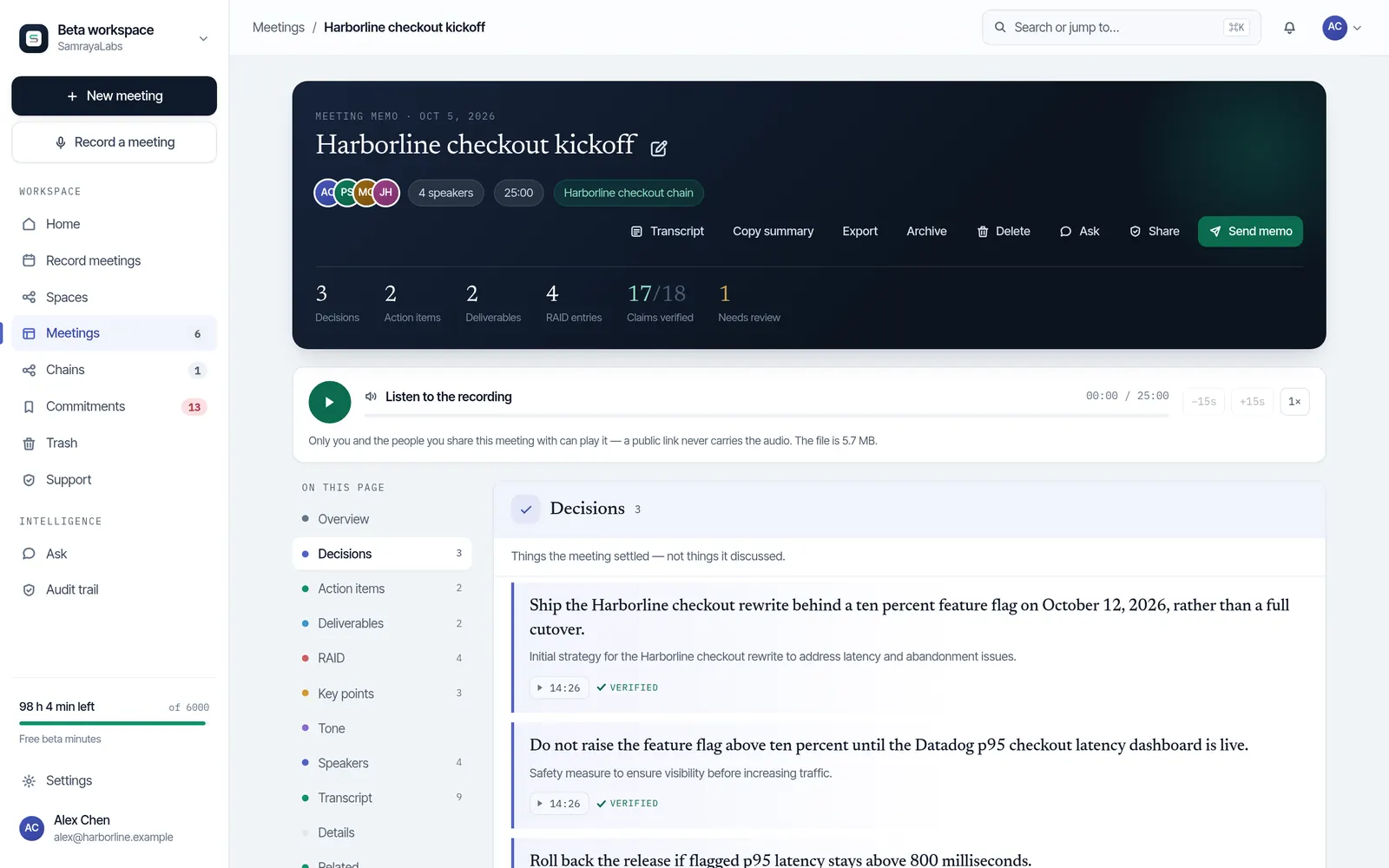
Document capture ships in sprint 6; the liveness check moves to sprint 8.
Chosen over shipping a check known to fail on low-end Android.
Meeting AI solved recording. It did not solve follow-through. MeetingMemo produces a memo you can forward without editing — where every decision, owner and date links to the seconds of audio it came from, and every commitment gets chased until it closes.
Document capture ships in sprint 6; the liveness check moves to sprint 8.
Chosen over shipping a check known to fail on low-end Android.
“Then we don’t ship it half-broken. Move liveness to sprint eight and ship document capture on its own.”
Capture is commoditised — a dozen tools will hand you a transcript and five bullets. What none of them give you is a record anyone trusts enough to act on, or a system that keeps working once the call ends.
Four stages, all visible while they run. No silent progress bars — you always know which stage a meeting is in, and a failure names its cause instead of showing a red toast.
Drop a recording, or attach the spec it was about. Audio and video, up to two hours, English and Nepali including code-switching.
A timestamped transcript with speakers separated — the evidence substrate everything else is checked against.
Agents extract decisions, actions, deliverables and RAID. A reviewer then matches every claim to an exact span — or flags it.
You approve the send. Nothing leaves the product without a human saying so, and open commitments keep surfacing until they close.
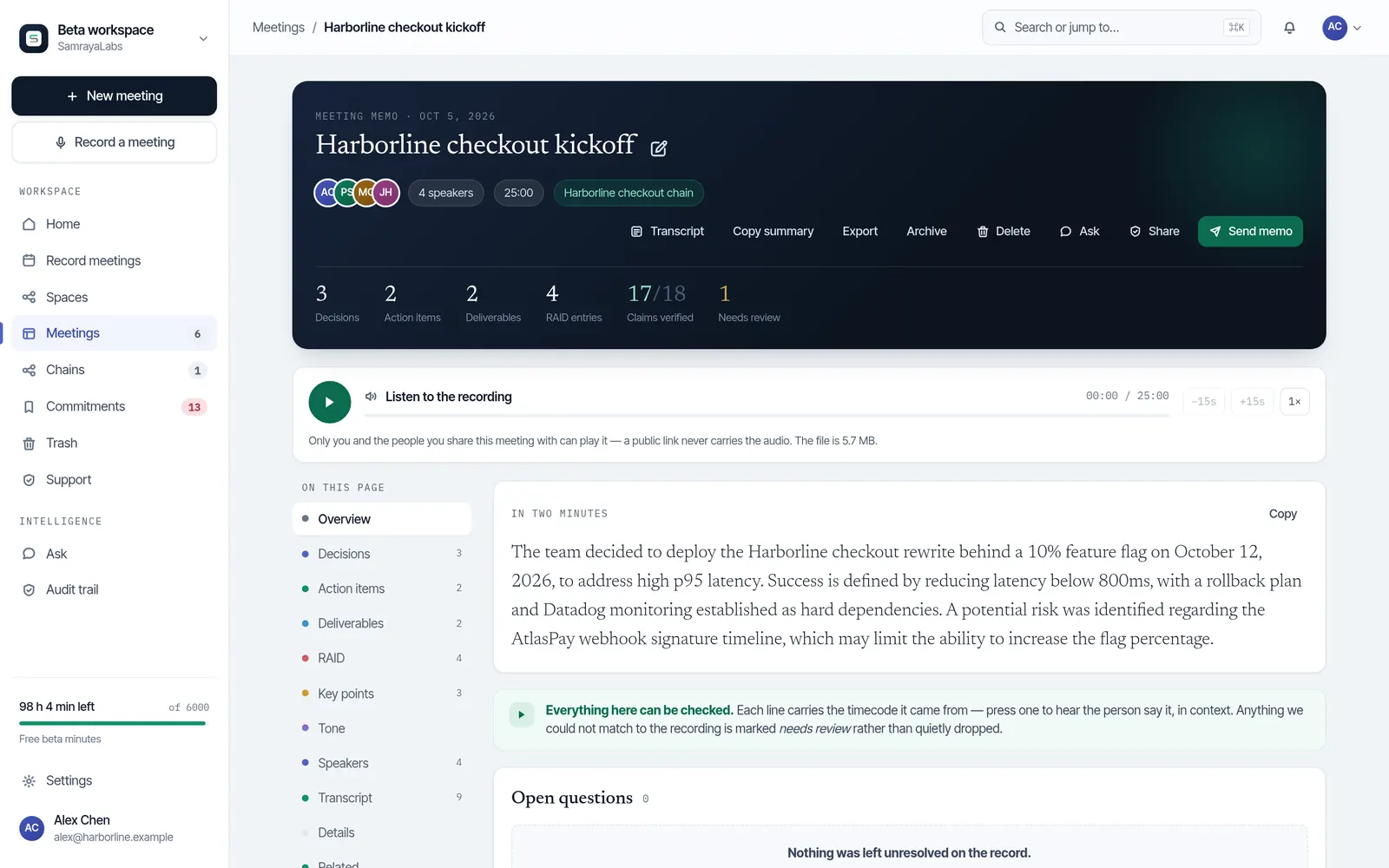
If the system cannot ground a claim in something a human said, it does not make the claim. That single rule is why the memo is worth forwarding.
Every decision, action item and risk carries the seconds it came from. One click opens the transcript at that point with the quote highlighted. Settle disputes in twenty seconds instead of replaying an hour.
A separate reviewer checks each claim against an exact transcript span. Anything it cannot match stays in the memo with a “needs review” flag, because a gap you can see is worth more than a sentence you cannot trust.
If nobody took the action out loud, the memo says “no owner stated” rather than guessing a name. The unassigned item is the most useful line in the document.
Agent steps, tool calls and human approvals are written to an audit trail with a correlation ID — queryable, exportable, and built for the person who has to assure the process.
“That assumption needs testing before we lock the flow.”
One in eighteen claims on a typical meeting gets flagged. You see all eighteen.
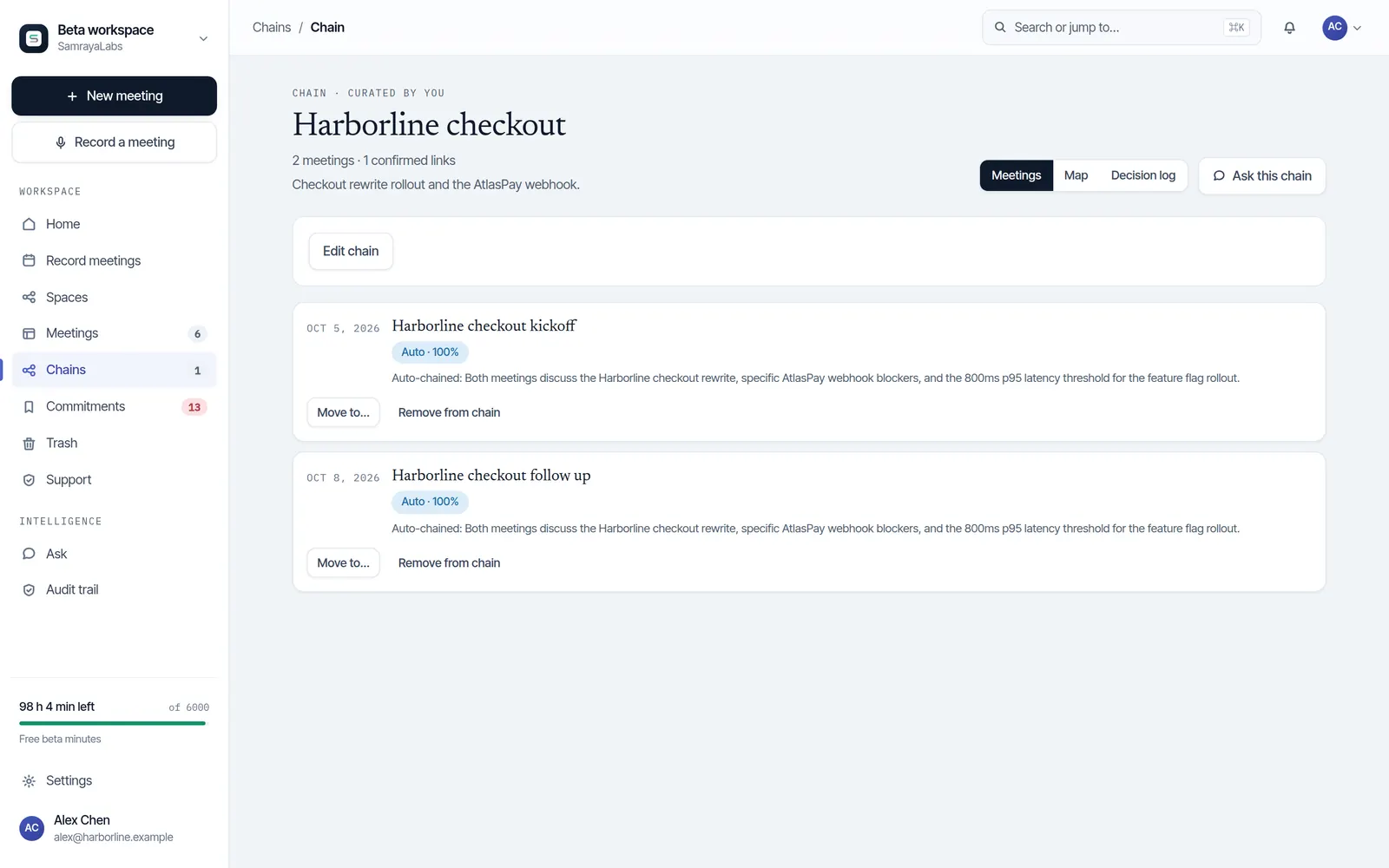
MeetingMemo proposes how your meetings connect. You draw the final shape — a path, a fork, a merge — and that shape decides what gets searched, and in what order the decision log reads.
Links only run forward, so cycles are impossible and the canvas can never contradict the calendar.
Suggested links arrive dashed, with their confidence and the reason in plain language. Confirm or dismiss.
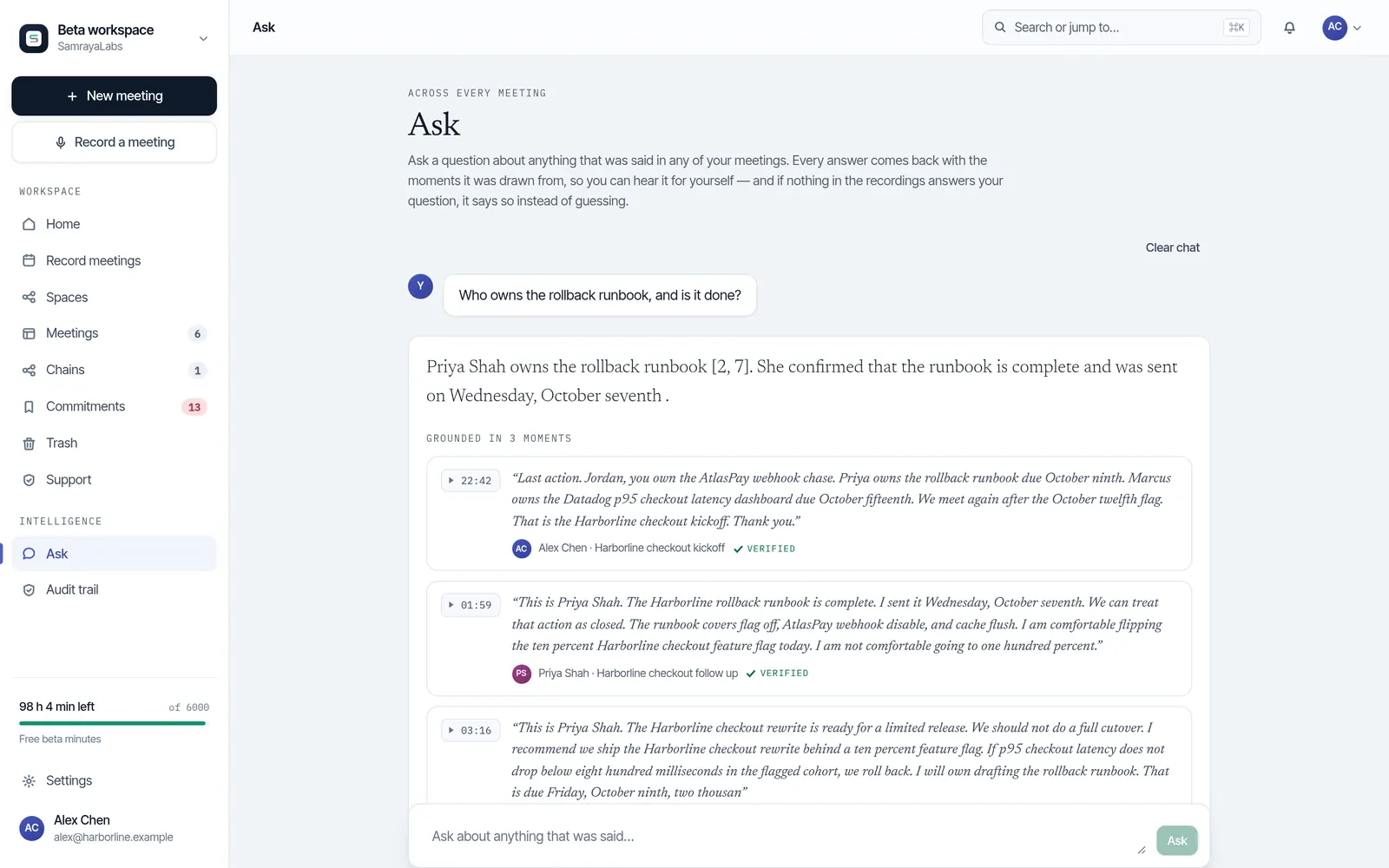
Select a meeting and ask across everything upstream of it. That answers “how did we get here”, which a flat folder cannot.
“I used to rewrite every AI recap before it went near the exec team. Now I forward it.”
“Meeting seven opens with what happened in six. The agenda writes itself.”
“I can show who approved what, with a correlation ID, without asking anyone.”
Treated accordingly, and stated as commitments rather than badges.
Your recordings and transcripts are never used to train foundation models. Product commitment and contractual term.
Multi-tenant SaaS, private cloud, or fully on-premises. Packaging choice — the analysis is identical.
Configurable in-meeting announcement and consent capture, written to the audit trail per meeting.
Workspace-level retention policy for audio, transcripts and artifacts, with deletion that actually deletes.
We onboard design partners a few at a time so each workspace gets real attention. Tell us what you run and we will get you in.